
Documentation
Introduction to documentation for Embodied Carbon Policy Reduction Calculator for Buildings
The Embodied Carbon Policy Reduction Calculator for Buildings functions based on three major components:
- Building area projections for the United States
- Embodied carbon intensity data for typical building types across life cycle stages A-C
- Methodologies for modeling approximate outcomes of different policy types
The tool takes building area projections, multiplies them by embodied carbon intensity data, and displays the result in the form of text, graphs, or tables. The interface also allows users to modify different inputs and outputs to model different policy scenarios and compare to a baseline scenario. The data for the Embodied Carbon Policy Reduction Calculator for Buildings was prepared using Python and a variety of public and open-source data sources. The user interface for this project was written using Svelte 5.
Calculations
See image below for a summary of inclusions and exclusions of the data model.
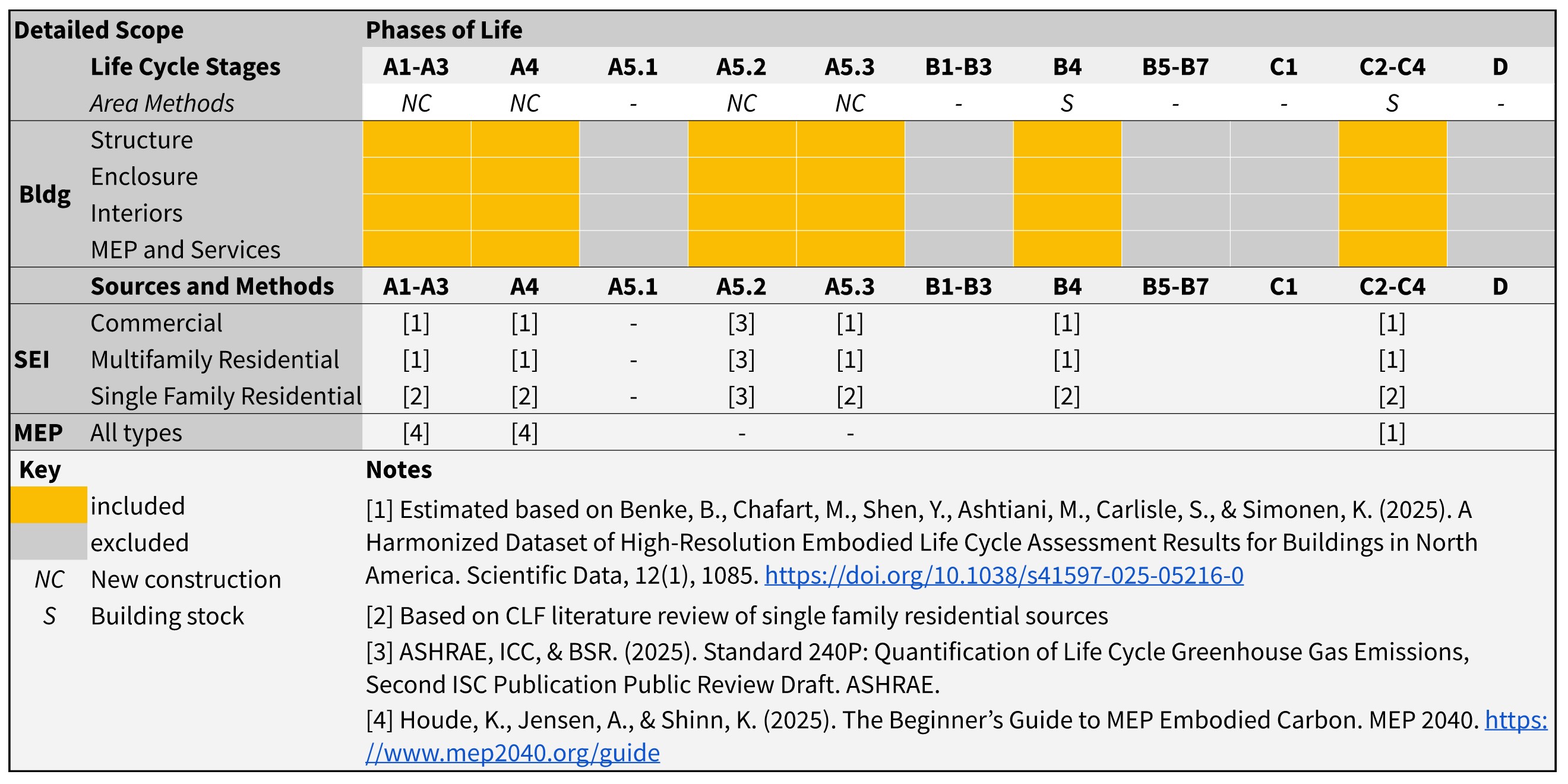
The tool estimates impacts based on generalized building typologies, including:
- Commercial
- Multifamily Residential
- Single Family Residential
These typologies were chosen to provide sufficient granularity for users while still providing defensible background data and methodologies. For the purposes of this tool, commercial construction is meant to encompass all non-residential typologies.
The tool provides the following physical scopes for analysis:
- Structure (Superstructure and foundations)
- Enclosure
- Interiors
- Mechanical, Electrical, and Plumbing (MEP)
The tool estimates impacts associated with the following life cycle stages:
- A1-A3: Manufacturing
- A4: Transportation to site
- A5.2: Construction emissions
- A5.3: Construction wastage
- B4: Replacement
- C2-C4: End-of-life